Tips
Best Time to See Northern Lights in Finnish Lapland
The first time you see the northern lights, you usually hear yourself...
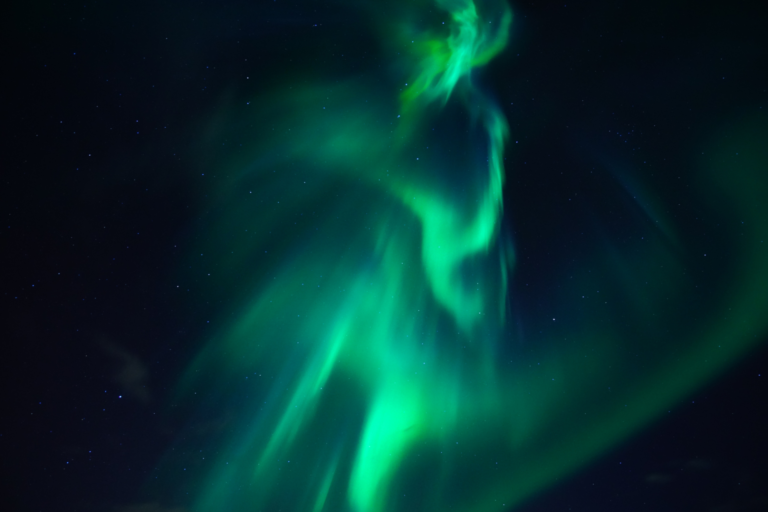
A northern lights holiday in Lapland rarely starts with a forecast app. It starts with a quiet evening, a warm cabin and the decision to step outside one more time before bed. The temperature drops, the snow muffles every sound, and somewhere above the treeline a pale-green ribbon brightens over the fells.
Levi sits at roughly 67.8°N, well inside the auroral oval. Its birch forests and frozen lakes give you something most aurora destinations cannot: a stay where the sky is part of the rhythm of the holiday, not a single tour booked in advance.
A regular Lapland trip is built around days — skiing, snowmobile rides, husky farms, dinners — and the evening is whatever is left after that. An aurora holiday flips the priority. The day fills the gap between two long, dark, sky-watching nights, and the trip is planned so you have the patience and the location to be outside when the sky decides to perform.
Three things shift in practice. Location matters more than usual — staying in the village core under street lamps removes most of the sky from the equation. Trip length matters more than usual — auroras do not appear on demand, and a single night gives almost no statistical room. Evenings are deliberately unstructured — kept free, with warm clothing ready and space to step outside whenever the sky clears.
For month-by-month timing, KP forecasts and visibility statistics, our companion guide on the best time to see the northern lights covers the science. This page is about the holiday itself: where you sleep, how the evenings flow, and how to choose dates that give the sky a fair chance.
The single biggest decision on a northern lights trip is where you sleep. The fells around Levi sit inside the auroral oval, but light pollution from the village core washes out the dimmer displays that make up most nights. A cabin a few kilometres from the lifts, with a view north over an open clearing or a frozen lake, will outperform a hotel balcony in the village every time.
Three accommodation styles dominate aurora holidays in Finnish Lapland, each with clear trade-offs.
Traditional cabins and chalets are the most common and most flexible choice. A well-placed log cabin with a private sauna, a hot tub on the terrace and a view away from village lights makes a comfortable base for long stays — watch from the terrace, warm up inside, step out again when conditions improve. Aavalevi’s Lapland accommodation is selected with this balance in mind: close enough to Levi’s services, far enough from its glow.
Glass igloos and aurora cabins put a panoramic window directly above the bed. Excellent for waking up to the sky without dressing for −20 °C, and they photograph beautifully. Trade-offs: smaller interiors, higher nightly rates, and dependence on a single view direction. They work best as one or two nights inside a longer cabin stay.
Wilderness lodges and remote cabins sit furthest from light pollution and give the darkest skies. Best suited to travellers who want quiet days and are happy with a longer drive for activities and supplies.
For most aurora holidays a cabin is the right primary base, with glass-roofed accommodation as an optional one-night experience.
People often imagine a single dramatic moment with a green sky overhead. The reality is calmer and slower, and planning around that reality is what separates a satisfying trip from a frustrating one.
A typical evening at a cabin near Levi runs something like this. Around dinner you check the Finnish Meteorological Institute aurora forecast and a cloud-cover forecast. If magnetic activity is rising and the sky looks at least partly clear, coats and headlamps stay near the door. You spend an hour or two indoors — reading, sauna, conversation — and step outside every twenty to thirty minutes to scan the northern horizon.
The first sign is usually a faint grey-green band low to the north that the camera sees more vividly than the eye. From there the display can fade back, hold steady, or escalate into the moving curtains people travel for. Many sightings happen between roughly 21:00 and 01:00, with the strongest activity often in the late-evening window. Patience plus warmth indoors beats four straight hours standing in the cold.
Aurora forecasts are probabilistic. Even on a good geomagnetic night, cloud cover can hide the display; on a clear night, magnetic activity may stay flat. The longer you stay, the more independent chances you give the sky.
For a serious northern lights trip we recommend at least four nights, with five to seven the comfortable range. Three nights can work if you are lucky, but you have very little buffer if the first two evenings are cloudy. Seven nights gives almost every guest at least one strong sighting in the active season.
Levi’s high latitude means displays are visible at relatively modest geomagnetic activity — KP 2 or 3 is often enough for a clear sighting. You do not need a major solar storm, just clear skies and patience.
The best months for aurora-focused stays are the dark-sky months from late September through mid-March. Our seasonal pages cover the texture of each: November holidays for the polar-night atmosphere without Christmas crowds, January holidays for the deepest winter and quietest weeks, and February holidays for the longest run of cold, clear nights.
The point of a northern lights holiday is not to do nothing during the day. It is to choose activities that leave you energised rather than exhausted by 21:00.
Snowshoe walks at dusk, short husky or reindeer rides, cross-country skiing on prepared trails and an unhurried sauna afternoon all pair well with late evenings outside. One guided northern lights tour by minivan or by snowmobile early in the trip is worth considering — the guide takes you well beyond village light and reads the sky for you. Browse the full book Lapland activities catalogue or the broader overview of things to do in Lapland for ideas that fit a slower-paced aurora trip.
Avoid full-day high-intensity programmes every single day. Back-to-back snowmobile safaris and late dinners often leave travellers too tired to step outside on the night the sky finally clears.
Comfort outside in the dark is the difference between a ten-minute glance and an hour of patient watching. The cabin handles warmth indoors; the layers handle the rest.
Essentials: merino base layers, a thick mid-layer, an insulated outer shell, snow trousers, mittens (warmer than gloves), a wool hat, two pairs of wool socks and proper winter boots rated for sub-zero conditions. Hand warmers help on long sessions. A red-light headlamp preserves night vision. To photograph the aurora, a tripod and a camera with manual exposure (start around 10–20 seconds at f/2.8, ISO 1600–3200) will far outperform a phone.
A thermos of hot tea or berry juice on the terrace turns waiting into something pleasant rather than something endured.
A handful of small planning mistakes account for most disappointed aurora trips.
Staying in the village centre under street lights. Even a strong display looks washed out from a lit balcony. Choose accommodation with darkness in at least the northern direction.
Booking only two or three nights. Aurora viewing is statistical. Short trips can succeed, but the variance is high and a miss stings.
Treating the forecast as a guarantee. A “low” KP forecast in Lapland still produces visible auroras on many nights thanks to the high latitude. A “high” KP with full cloud cover produces nothing. Always check both magnetic activity and cloud cover.
Filling every evening. A late village dinner means you are inside, in light, during the prime viewing window. Keep at least three evenings free.
Checking the forecast only on arrival night. Build a habit of checking around dinner and again before bed for every night of the trip.
At least four nights, with five to seven the comfortable range. That gives enough independent evenings to absorb cloudy nights or quiet geomagnetic activity and still come home with a strong sighting.
For one or two nights inside a longer cabin stay, yes — watching the sky from a warm bed is worth doing once. As a full-trip choice they are less flexible: smaller interiors, fixed view direction, higher nightly rates. Most travellers are happier in a well-placed cabin with a sauna and a clear northern view.
Sometimes. A cabin with a large north-facing window, a glass-roofed bedroom or a panoramic sauna can give sky access without leaving the building. For most stays the best viewing is from the terrace or a short walk to a nearby clearing — plan on dressing warmly and stepping outside.
Levi sits at a high latitude inside the auroral oval, so displays are visible at modest geomagnetic activity — typically from KP 2 upwards on clear nights. Clear skies and patience matter more than chasing a high KP figure.
A cabin a few kilometres from the village core, with a clear view to the north over a frozen lake or open clearing, gives the best balance of comfort and dark skies. Levi works well because the surrounding fells and forest stays sit inside the auroral oval but away from light pollution. A glass igloo or aurora cabin layered into a longer cabin trip adds a memorable one- or two-night experience without the trade-offs of staying in one for the full week.
Cloud cover is the most common reason a trip misses the aurora. Longer stays reduce the risk, and a cabin with sauna, hot tub and warm interiors makes cloudy nights enjoyable rather than a write-off.
A good northern lights holiday is built from a small number of decisions: stay long enough, pick a cabin away from village lights, keep evenings free, and dress for the cold. Everything else is patience and a sky that does what it wants.
Aavalevi curates cabins around Levi and Ylläs that fit this kind of stay — quiet locations, warm interiors, saunas and terraces with northern views, where stepping outside one more time before bed feels like part of the holiday.
Browse aurora-friendly cabins and plan your Lapland holiday with Aavalevi →