Tips
Best Time to See Northern Lights in Finnish Lapland
The first time you see the northern lights, you usually hear yourself...
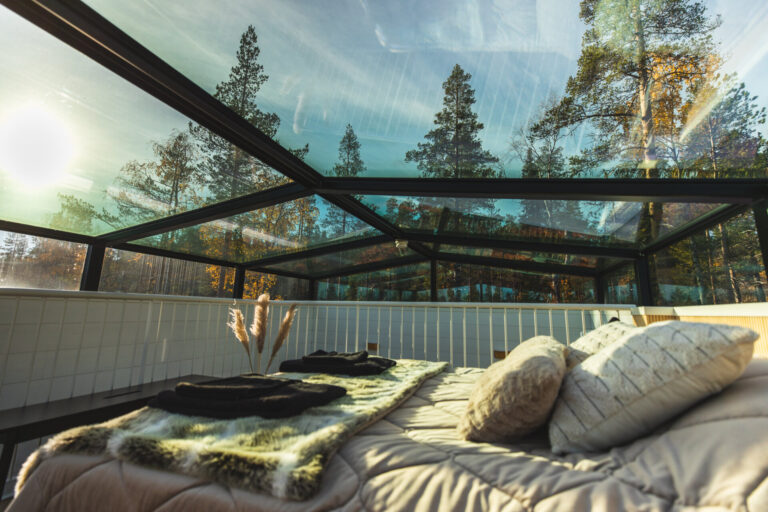
Lapland does not have one peak season. It has roughly eight of them — from the first snow in October, through the deep dark of polar night, to the green roar of midsummer when the sun never sets. The best time to visit Lapland depends almost entirely on which version of the Arctic you want: the one that crunches under your boots, the one that lets you canoe at midnight, or the one that turns every birch leaf gold for ten days in September.
At Aavalevi we rent privately owned cabins, apartments and log villas in Levi and Ylläs, just inside the Arctic Circle at roughly 67.8°N. Guests come back in different seasons for different reasons, and most are surprised by the seasons they had not considered. This pillar guide walks through every part of the year — the weather, the daylight, what is on, and who each month suits — so you can match the right month to the trip you actually want.
If you are planning your first visit and only have time for the headline:
Two factors drive everything else. The first is daylight: at Levi’s latitude, the sun stays below the horizon from roughly 12 December to 2 January (the polar night, or kaamos), and never sets at all for around 45 days from late May to mid-July (the midnight sun period). The second is snow cover, which is reliable from late November through April and often into early May on the fells.
Levi Ski Resort opens its season in early October on stored snow and runs through to early May — the 2025–2026 season opens on 3 October 2025 and closes 10 May 2026. Kittilä airport is roughly 15 km from Levi village, with direct winter flights from several European hubs.
Below, each season in detail.
October is Lapland’s quiet shoulder. The ruska colours fade through the first week, the first snow usually falls in mid-October, and by the last week the landscape is consistently white. Daylight is still generous — around 9–10 hours in early October, dropping to 5–6 hours by the end of the month. Temperatures sit between −5 °C and +5 °C, with frost most nights.
November is the month the Arctic switches over. By the third week, snow cover is reliable, the husky and reindeer farms have opened their winter programmes, and aurora viewing is at its statistical best because the nights are dark but the heavy cloud cover of mid-winter has not yet set in. Daylight drops fast, from around 5 hours at the start of the month to under 2 by the end. Temperatures usually land between −5 °C and −15 °C.
This is a strong period for travellers who want winter without the festive crowds, lower accommodation rates, and the highest probability of a clear-sky aurora night per dark hour. Our November holidays in Lapland guide has the month-specific detail on what is open, what is not, and how to plan around the rapidly shortening days.
December is the month Lapland is most famous for, and it earns the reputation. Levi sits inside the polar night zone, but only just — from around 12 December to 2 January the sun does not climb above the horizon, yet the day is far from black. You get two to four hours of soft blue twilight, often turning pink at the horizon, which locals call kaamos. Photographers love it. First-time visitors are usually surprised at how much you can do in it.
Temperatures during festive week typically sit between −10 °C and −20 °C, sometimes dropping below −25 °C on the clearest nights — and those clear, cold nights are when the aurora viewing is at its best. Snow cover is deep, ski runs are fully open, husky and reindeer farms are at full programme, and Levi village runs Christmas markets, candlelit cross-country tracks and live music through the festive week.
The trade-off is that Christmas week is also Lapland’s busiest and most expensive period. Husky safaris, reindeer rides and Santa visits sell out by October most years. If you are planning a December trip, our Christmas holidays in Finnish Lapland guide covers the practical side — what to book first, where to find a quieter Santa experience than Rovaniemi, and how to plan around the short usable daylight window.
January is the coldest month in Lapland and, for many guests, the most rewarding. Polar night lifts in the first week, daylight returns slowly (around 1–2 hours of usable light at the start of the month, climbing to 5+ hours by the end), and temperatures often hold between −15 °C and −25 °C. Snow is at its deepest. The festive crowds have left.
For aurora hunters, January is a strong month: long dark hours, frequent high-pressure clear-sky stretches, and a stable winter atmosphere. For active travellers, the cross-country trails are floodlit, the alpine slopes are at full capacity, and the silence outside the village is the kind you feel in your chest.
Our January holidays in Lapland guide goes into detail on what to pack for genuine cold, how to plan an itinerary around 4–5 hours of daylight, and which activities run on which days.
February shifts the balance. Daylight grows from around 6 hours at the start of the month to nearly 11 by the end, snow is at maximum depth, and temperatures, while still cold (−10 to −20 °C is typical), are usually milder than January.
Many returning visitors call February the sweet spot. You still have the full winter — deep snow, dog sledding, snowmobile tours, frozen lakes for ice fishing — but you also have enough light to do two activities in a day instead of one, and the aurora window is still long enough to reliably catch a display. Schools in many European countries have a half-term break in February, which makes it popular with families.
Our February holidays in Lapland guide breaks down the month with itineraries built around the longer daylight, which is the single biggest difference from January.
March and April are Lapland’s best-kept secret. Snow is still deep and reliable on the slopes — Levi typically holds full ski operations into late April and the 2025–26 resort season closes 10 May 2026 — but daylight has flipped. By late March you have 12+ hours of light, and by mid-April you are at 16+. The sun feels warm on your face for the first time since September.
Temperatures during the day often sit between −5 °C and +5 °C in March, climbing to 0 to +10 °C by April. Nights still freeze, which keeps the snow firm. This is the season for spring skiing, long cross-country tours, snowmobile day trips and outdoor lunches at slope-side restaurants. Aurora is still possible until early April but increasingly hard to see as the nights shorten.
If you have flexibility, late March is one of the most pleasant times to visit Lapland — full winter scenery, returning sun, and lower prices than December or February school holidays.
May is a transition month. The first half still has snow on the fells and lingering ski runs at Levi (the resort usually closes around 10 May). The second half is ruska‘s opposite: bare branches, brown landscape, melting lakes, swelling rivers. Locals call it the kevätpäivä — spring day, the long bright days before the summer green has filled in.
For most international visitors, mid-to-late May is the least scenic month and not what you want for a first Lapland trip. For experienced travellers who want quiet, low prices and bright sunlight without snow, it has its appeal.
By early June, Lapland has flipped completely. The lakes have opened, birch leaves are out, and the midnight sun period begins — at Levi the sun does not set at all for around 45 days from late May to mid-July. You can read a book outside at 2 am. Hikers can start a fell trail in the evening. The whole sense of time stretches.
Daytime temperatures usually sit between 15 °C and 25 °C, occasionally pushing 28–30 °C in July heatwaves. Nights are cool but never cold. The activity programme shifts to hiking, cycling, canoeing and lake swimming, with sauna and barbecue evenings stretching into the bright “night.”
Summer suits travellers who want long, unhurried days outdoors, families who want flexibility (no time pressure when there is no darkness), and anyone who has done winter Lapland and wants to see the same forests in green. It also tends to be cheaper than peak winter, with one caveat: mosquitoes peak from mid-June to late July, especially near lakes. A head net is genuinely useful in early summer.
For the broader summer activity programme, see our overview of things to do in Lapland during a stay in Levi — the same fells that carry ski lifts in winter become hiking and downhill bike trails.
If you ask a Finn when they would visit Lapland, many will say September. The autumn colour season — ruska — peaks in Levi during the second and third weeks of September, when birches turn yellow, dwarf shrubs go scarlet and rowans glow orange. Peak conditions in the Levi area typically run from mid-September into the last week, depending on the year.
Daytime temperatures sit between 5 °C and 15 °C, with frost some nights. Daylight is still long — 13+ hours at the start of the month, dropping to 11 by the end. Mosquitoes are gone. Hiking is at its best, the air is crisp and clear, and the light is what photographers come for.
By the last week of August the nights are also dark enough for aurora to return. Late August and September are statistically among the best months of the year for aurora viewing because clear-sky nights are common and the equinox effect lifts geomagnetic activity. There is no snow yet, so reflections come from lakes and frosted ground.
The aurora season in Finnish Lapland runs from late August to early April. Outside that window, the midnight sun keeps the sky too bright. Inside it, your odds depend less on the calendar month and more on three things: dark hours, cloud cover and where you stand.
Levi sits inside the auroral oval — the ring around the magnetic pole where aurora is statistically present every clear, dark night — so you do not need a major geomagnetic storm to see something. Aurora typically becomes visible in Levi from around KP 2–3, while travellers in southern Finland or central Europe might need KP 5+ for the same view.
For the month-by-month aurora outlook (which months have the longest dark hours, which have the clearest skies, and how to read short-term forecasts), see our deep-dive on the best time to see northern lights in Lapland. If you want a complete trip built around aurora viewing — including which cabin orientations matter and what to book in advance — our northern lights holidays in Lapland guide covers the planning side.
A few simple questions narrow the choice quickly:
Whichever season you choose, our Aavalevi cabins and log villas are set up for it — private sauna, fireplace, full kitchen, and locations close enough to Levi village for activities but far enough into the trees for silence.
For weather forecasts, daylight tables and aurora conditions, the Finnish Meteorological Institute runs an excellent free service. For event programmes and resort opening times during your stay, your Aavalevi host can share the latest local schedule on check-in.
There isn’t one — it depends on what you want. February and March are the strongest all-rounders for first-time winter visitors: deep snow, full activity programme, and enough daylight to fit two or three things into a day. For aurora-first trips, late November to mid-January is best. For summer, late June to mid-July. For autumn colours, mid-to-late September.
Early November, late April and May, and September tend to be the lowest-priced periods. Christmas week, New Year and February school holidays are the most expensive. Booking 6–9 months ahead for festive week is normal; for shoulder seasons, 2–3 months is usually fine.
No. From late May to mid-July the midnight sun keeps the sky too bright, and even in the second half of August nights only start getting dark enough by the last week. The aurora season runs from roughly late August to early April.
January is the coldest month, with daytime temperatures typically between −15 °C and −25 °C and occasional drops below −30 °C on calm clear nights. December and February usually sit between −10 °C and −20 °C. Cold in Lapland is dry and still, which makes it feel milder than damp 0 °C weather further south — provided you layer properly. Most activity operators provide thermal overalls and boots.
Yes, but it is a completely different trip. Summer Lapland is about midnight sun, hiking, lakes and slow days outdoors. There is no snow, no aurora and no Santa. If you want the postcard Christmas Lapland, come in winter. If you want long bright days and a quieter, greener Arctic, come in June or July.
Ruska peaks in the Levi area during the second and third weeks of September, sometimes extending into the last week depending on the year. Higher elevations on the fells turn first; lower forests follow over the next two weeks.
The best time to visit Lapland is the season that fits the trip you want — and the right base makes any season work. Aavalevi’s homes are chosen for that: close to nature, easy to settle into, with sauna and fireplace for the winter months and lake or forest access for the summer ones.
Whichever month you choose, the experience has space to unfold one day at a time.
Explore Aavalevi’s Lapland accommodation — or contact us for a recommendation based on your dates.